
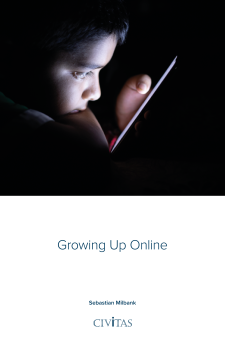
Growing Up Online
Sebastian Milbank, October 2026
Our children are growing up online. Almost every child in Britain is using the internet by the age of nine and over half own a smartphone by eleven, some spending up to six hours a day scrolling social media. The UK Government’s proposed social media ban for under-16s comes in response to mounting evidence that digital childhoods are harming young people and their mental health, with online exposure to pornography, violence, misogyny, self-harm and eating disorder content widely identified as the main causes for concern.
These must be taken seriously – but just as worrying are the more subtle ways in which technology is reshaping young minds, and the real-world experiences they are missing out on as a result. As technology intrudes on almost every aspect of life, at home and in school, in-person activities are being increasingly sidelined. Children today spend less time than ever exploring their physical environments, forming real-life relationships and discovering offline hobbies. Their attention and ability to concentrate are also being markedly diminished, the full consequences of which we may not see for years to come.
In Growing Up Online, Sebastian Milbank investigates how these harms are already affecting different age groups and demographics in Britain today: though many middle-class parents are taking action to curb technology at home, children from lower-income families display alarming rates of screen use, with schools reporting sleep deprivation, poor concentration and bad behaviour as a result. Current approaches focused solely on harmful content, he argues, fail to address the behavioural, mental and emotional damage caused by screen addiction and attention displacement, even in seemingly innocuous forms such as ‘Edtech’.
Milbank thus advocates a shift away from policies focused solely on limiting children’s exposure to harmful content towards a more comprehensive public health, educational and civil society approach. He argues that, while we must work to make digital technologies less intrusive and behaviourally addictive, this must also be accompanied by a positive strategy for rebuilding offline childhoods and introducing young people to technology in a way that promotes agency rather than passive submission.
About the Author
Dr Sebastian Milbank is a researcher and columnist for The Critic magazine. He has previously held roles as Executive Editor of The Critic and Newman Intern at The Tablet. He holds a PhD in the Philosophy of Religion from the University of Cambridge, and is the author of a forthcoming book on the concept of citizenship in the ancient Greek and Christian worlds.
Download PDF